Catholic Answers RSS
I don’t really like social network services, especially Facebook, though I am using Twitter. Those social network services just push any useless feeds, which they claimed to be personalized based on our surfing behaviour. However, they are just like junk food, which MAY favour my appetite. That’s why I prefer RSS news feeds, which I choose my own preferred websites (especially blogs) and follow the news.
During the lent season (today is Easter Sunday), I try my best to spend more time on spiritual readings, in order to strengthen my faith. There are too many temptations in the world, and there are a lot of challenges from the atheism. That’s why I spend more time to read the articles from Catholic Answers.
Catechism and the Pope
I am neither theologian nor bible scholar. But just a Catholic layperson and would like to share my opinions.
The most recent hot issue is the changing of the Catechism about death penalty by Pope Francis. Then throughout the Twitter, I can see there are a lot of debates on this issue, including some people criticising the Pope.
Therefore, in this post, I will share some of my understandings.
Regarding the Catechism of the Catholic Church (CCC), according to USCCB Question 17,
Prayer life
There are three ways of prayer according to Catechism of the Catholic Church.
- Vocal prayer 口祷
- Meditation 默想(运用思维、想像、情感、渴望)
- Contemplation 心祷
What is the difference between meditation and contemplation? The following part is a summary from here.
Contemplative prayer is more passive or sublime experience of God. Meditative prayer is more from our work of seeking God (though with the aid from God). Contemplative prayer can be distinguished as the pure work from God.
Grace, grace, grace, which I always confused
When I read Catechism, the term “grace” is quite confusing. There are at least four types of grace I read: sanctifying grace, habitual grace, actual grace, and special grace. So, recently, I tried to solve my confusion by going through these differences. By reading the Catechism again and again (the related part only), and also some other resources, so, I simplify them,
Sanctifying (or deifying) grace = 圣化恩宠, permanent state of grace. Habitual grace = 常居的恩宠(宠爱), is also sanctifying grace. Actual grace = 现时的恩宠(宠佑), transient help to act (intervention of God), different from habitual grace. Also called “gratuitous grace” in Summa Theologica. Special grace = 特别的恩宠(神恩), also charism, oriented to sanctifying grace. Considered actual grace.
Catholic particular judgement in programming (for fun only)
[sourcecode language=“c”] int particularJudgement(State* state) { if(state->grace > state->sin) { if(state->punishment) { return PURGATORY; } else { return HEAVEN; } } return HELL; } [/sourcecode]
Prayer Clock and JPrayer Clock 0.1.2 released
Prayer Clock and JPrayer Clock 0.1.2 are released. Anyone who likes, you can download. And the source code is also available. Feel free to edit.
Novena to the Holy Spirit
The Novena to the Holy Spirit is started on Friday, 6th Week of Easter. We can start the prayers by today.
However, in my Prayer Clock, I have mis-calculated the day. Please, if you are interested, download the prayers.xml from my site.

Prayer Clock 0.0.6
Just to announce that the Prayer Clock 0.0.6 is released.
I have redesigned the algorithm and the data structure. Besides that, some features are added such as “Prayers” item that allows the user to show different prayers. The followings are some screenshots:
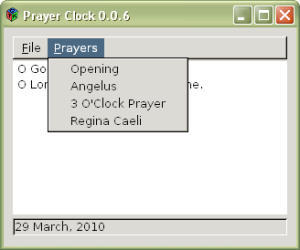
GTK+ in Windows.
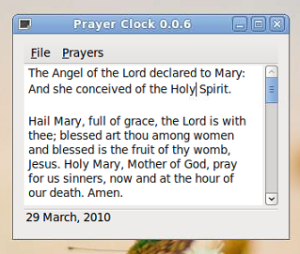
GTK+ in Ubuntu Linux. Very nice, right?
Since Easter is coming, hopefully I have time to add in Divine Mercy Novena.
Prayer Clock
Written by using C and C++, depends on GTK+ and Expat. I spent about 3 days to study GTK+ and Expat since never used them before. I wrote this application because sometimes, I want to say a prayer, especially Angelus. But I need the prayer to read and also a reminder. So, I decided to wrote this program, at the same time I can also learn about GTK+ and Expat. And I decided to open source it as a contribution to Catholics.
Wedding at Cana
Today’s Gospel reading is very nice. And it is so meaningful. I like it very much.
When they were ran out of wine, Mother Mary said to Jesus, “They have no wine”.
This is how we should pray. We always pray to God that, we want this, we want that, we want a car, we want a house, we want money, we want a happy life, etc. We always ask for God what we want, because we think that we know what we need. But God knows better than us. God knows what we need. “They have no wine”, and Jesus knew what he should do.